.svg)
Les Grammys définissent les règles de l'IA pour les récompenses
Les Grammys viennent de tracer une ligne claire concernant l'IA, et cela a de réelles conséquences sur la manière dont les artistes créent, sortent leurs œuvres et même se qualifient pour les plus grandes récompenses musicales. Nous expliquons ce que les nouvelles règles de la Recording Academy signifient réellement, où l'IA est utile et où elle vous disqualifie, et pourquoi la « contribution humaine » est désormais l'expression la plus importante que les artistes doivent comprendre. Si vous utilisez des outils d'IA à n'importe quelle étape de votre processus de travail, ou même si vous y pensez, cette lecture est essentielle pour éviter des erreurs coûteuses et rester compétitif alors que l'industrie redéfinit rapidement les règles.

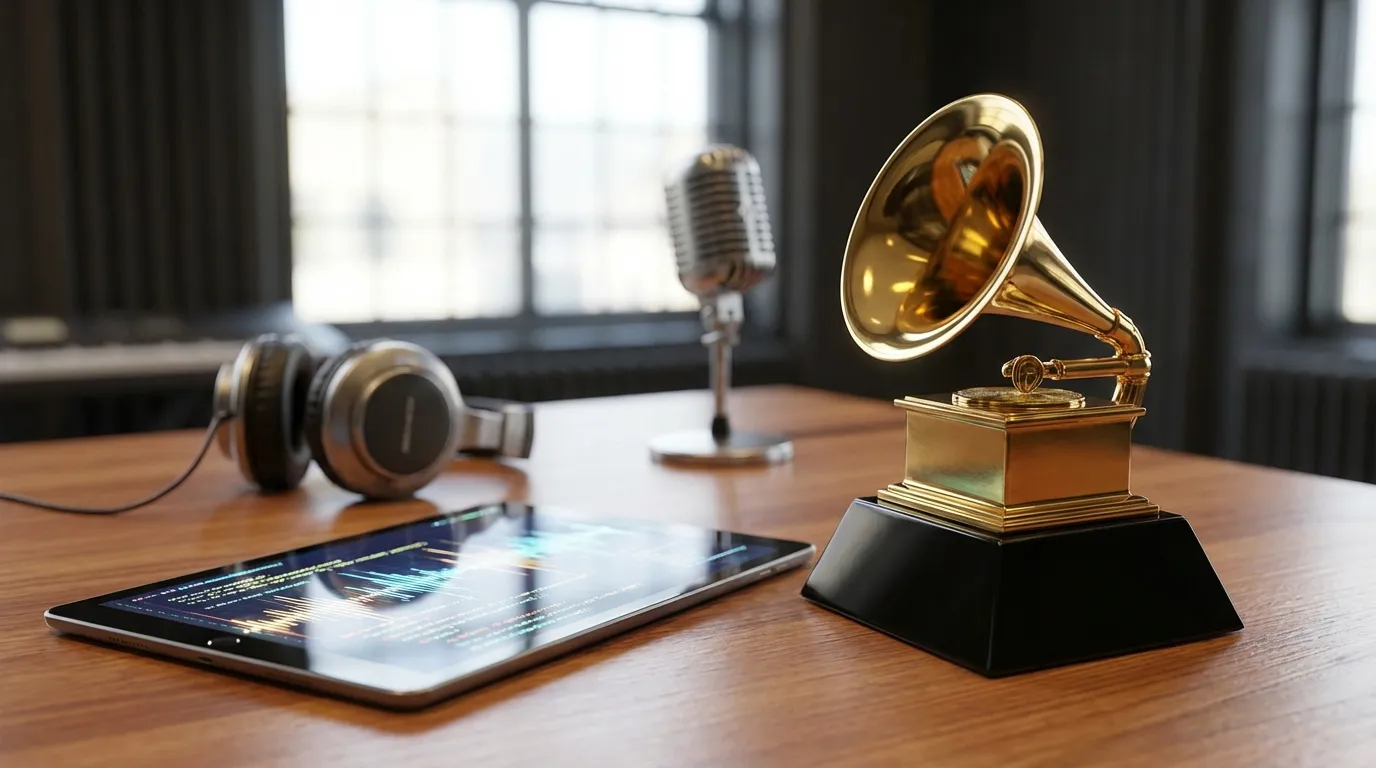
La Recording Academy a fait l'effet d'une bombe qui redéfinit la façon dont les musiciens perçoivent l'intelligence artificielle dans leur processus créatif. Lorsque les Grammys définissent les règles de l'IA pour l'éligibilité aux récompenses, toute l'industrie y prête attention. Ces nouvelles directives établissent des limites claires entre l'art humain et le contenu généré par machine, changeant fondamentalement ce qui est éligible aux plus hautes distinctions musicales. Pour les artistes indépendants utilisant des outils d'IA en production, comprendre ces distinctions n'est plus une option.
La position de la Recording Academy sur la créativité humaine
La position de l'Académie est sans équivoque : la créativité humaine doit rester au centre de toute œuvre éligible aux Grammys. Il ne s'agit pas de rejeter la technologie, mais de préserver ce qui donne un sens à la musique.
L'exigence fondamentale de la paternité humaine
Seuls les créateurs humains peuvent recevoir des nominations aux Grammys. Les systèmes d'IA, aussi sophistiqués soient-ils, ne peuvent pas être crédités comme artistes, auteurs-compositeurs ou producteurs sur les soumissions éligibles. La personne qui appuie sur les boutons, prend les décisions créatives et façonne le produit final doit être humaine. Cela signifie que votre morceau assisté par l'IA peut toujours être éligible, mais vous devez démontrer une implication humaine substantielle dans le processus créatif.
Définir l'exception « De Minimis » pour les outils d'IA
L'Académie applique une norme « de minimis », ce qui signifie que des contributions d'IA minimes ou triviales ne disqualifient pas une œuvre. L'utilisation de l'IA pour des tâches de base comme la réduction du bruit, la correction de la hauteur ou la génération de pistes de référence entre dans les limites acceptables. Pensez-y comme un correcteur orthographique pour l'écriture : utile, mais ne faisant pas le travail créatif réel.
Critères d'éligibilité pour les œuvres assistées par l'IA
Comprendre où se situe la limite entre l'assistance IA acceptable et la génération IA disqualifiante détermine si votre musique peut concourir.
Distinguer entre l'audio généré par l'IA et l'audio amélioré par l'IA
Le contenu généré par l'IA signifie que la machine a créé les éléments musicaux fondamentaux : mélodies, progressions d'accords, paroles ou arrangements. Le contenu amélioré par l'IA signifie que des humains ont créé ces éléments, puis ont utilisé des outils d'IA pour les affiner. Une prise vocale passée par un logiciel de mastering IA ? Améliorée. Une mélodie crachée par un algorithme que vous avez ensuite enregistrée ? Générée. La distinction est d'une importance capitale.
Le rôle des crédits et des seuils de contribution
Les soumissions aux Grammys exigent des informations détaillées sur les crédits. Si l'IA a joué un rôle significatif dans la création d'un élément, cela doit être divulgué. L'Académie examine ces crédits pour déterminer si la contribution humaine atteint leur seuil. Des crédits vagues ou des tentatives d'obscurcir l'implication de l'IA peuvent entraîner une disqualification, même après l'annonce d'une nomination.
Implications pour les catégories d'écriture de chansons et de production
Différentes catégories des Grammys appliquent ces règles avec une rigueur variable, en particulier lors de l'évaluation des contributions créatives par rapport aux contributions techniques.
Règles pour le Meilleur Nouvel Artiste et les prix de performance
Les catégories de performance se concentrent sur l'élément humain de l'exécution. Si une IA a généré la piste d'accompagnement mais qu'un humain a livré une performance vocale authentique, cette performance peut toujours être éligible. Le prix du Meilleur Nouvel Artiste exige que l'artiste lui-même soit humain et démontre une véritable créativité à travers son œuvre soumise. Des plateformes comme Releese aident les artistes indépendants à maintenir une documentation claire de leur processus créatif, ce qui devient précieux lors de la soumission pour examen.
Comment les paroles et mélodies d'IA impactent les nominations
Les catégories d'écriture de chansons font l'objet de l'examen le plus rigoureux. Les paroles ou mélodies générées par l'IA disqualifient une chanson de la considération pour le titre d'Auteur-compositeur de l'année. Même une implication partielle de l'IA dans l'écriture peut compliquer l'éligibilité. Si vous avez utilisé un outil d'IA pour trouver des rimes, mais que vous avez écrit vous-même chaque parole finale, documentez clairement ce processus.
Considérations éthiques et juridiques dans l'industrie musicale
Au-delà de l'éligibilité aux Grammys, ces règles reflètent des préoccupations plus larges concernant l'authenticité et la propriété dans la musique.
Aborder les préoccupations relatives au droit d'auteur et à la propriété intellectuelle
Les systèmes d'IA entraînés sur de la musique protégée par le droit d'auteur soulèvent des questions de propriété ambiguës. Les règles de l'Académie contournent ce débat en se concentrant sur la paternité humaine plutôt que sur les données d'entraînement de l'IA. Cependant, les artistes doivent comprendre que l'éligibilité aux Grammys ne garantit pas la protection du droit d'auteur pour les œuvres assistées par l'IA. Les cadres juridiques n'ont pas encore rattrapé la technologie.
Protection de l'image de l'artiste et des échantillons vocaux
Les voix deepfake et le clonage vocal par IA soulèvent de graves problèmes éthiques. L'utilisation de l'IA pour reproduire la voix d'un autre artiste sans autorisation enfreint à la fois les règles des Grammys et potentiellement la loi. L'Académie interdit spécifiquement les soumissions présentant des ressemblances vocales non autorisées, quelle que soit la crédibilité de leur génération.
L'évolution future des Grammy Awards à l'ère numérique
Ces règles ne sont pas permanentes. La Recording Academy s'est engagée à réviser et à mettre à jour ses lignes directrices sur l'IA à mesure que la technologie évolue. Ce qui est interdit aujourd'hui pourrait être acceptable demain, et les zones grises actuelles auront probablement des limites plus claires. Les artistes doivent s'attendre à des mises à jour annuelles de ces politiques et planifier leurs processus créatifs en conséquence.
L'approche intelligente ? Utilisez l'IA comme un outil, pas comme un substitut à votre créativité. Documentez votre processus de manière exhaustive. Maintenez la prise de décision humaine au centre de votre travail. Les Grammys récompensent l'art, et cela signifie toujours l'art humain. Il reste à voir si ces limites évolueront avec le temps, mais pour l'instant, le message est clair : votre talent, vos décisions, votre musique.
Gérez votre activité musicale depuis une plateforme unique
Pré-enregistrements à vie, distribution et gestion des redevances dans un seul espace de travail.